

Motor Oil and the Evolution of Automotive Fluids
Motor oil has long been the foundation of automotive lubrication. It protects internal combustion engines from friction, excessive heat, and premature wear, allowing vehicles to operate reliably under demanding conditions. For decades, motor oil was the most critical fluid in any vehicle.
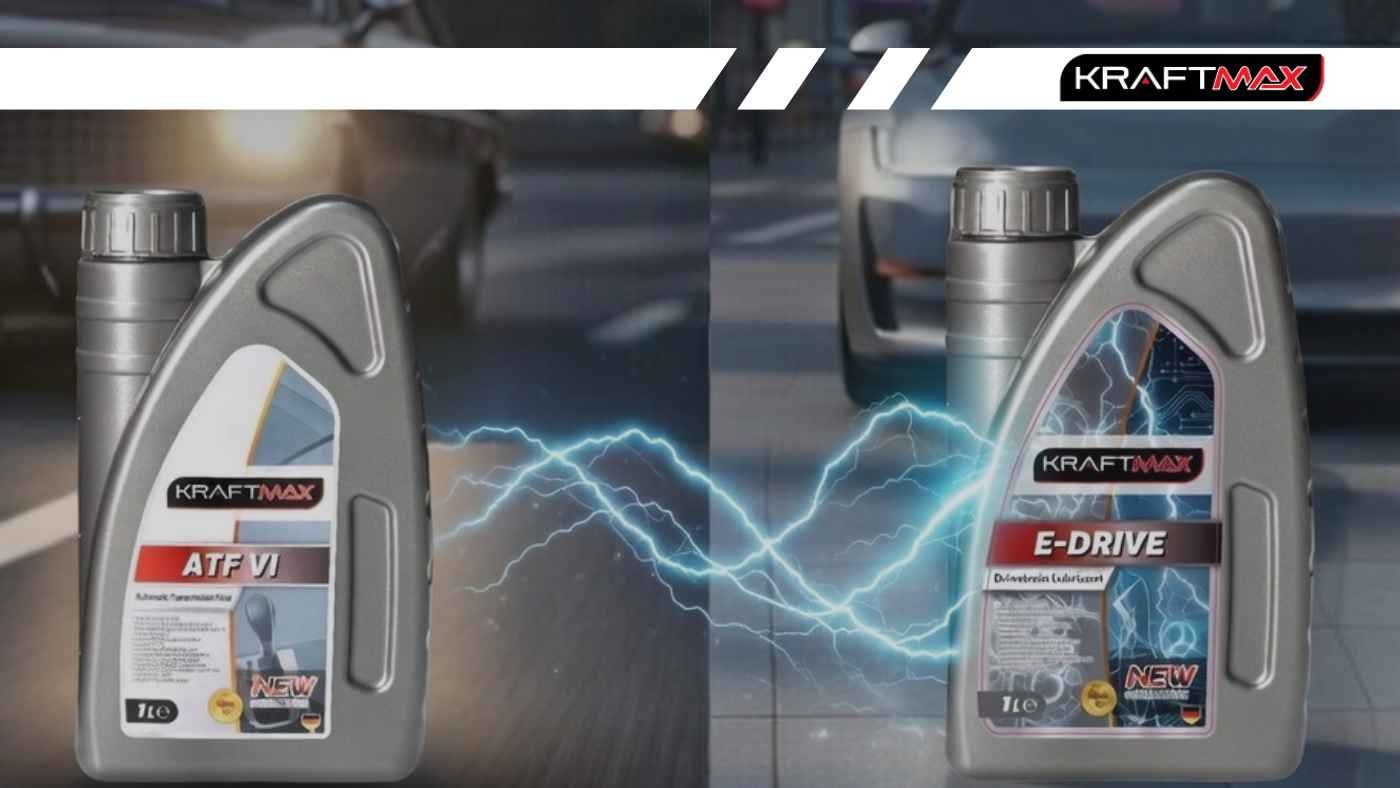
However, as vehicle technology evolved, engines were no longer the only systems requiring advanced lubrication and cooling. Automatic transmissions introduced new mechanical and hydraulic challenges, leading to the development of automatic transmission fluid (ATF). Today, with the rise of electric vehicles, those same lubrication principles appear again in the form of E-drive fluid, designed specifically for electric motors and power electronics.
Understanding how motor oil, ATF, and e-drive fluids differ, and how they work together across generations of vehicles, helps clarify the future of automotive lubrication, see the opportunities in the market, and hopefully a fast action for you to become the one and only distrinbutor of KRAFTMAX Lubricant in your country.
What Motor Oil Does and Does Not Do
Motor oil is engineered exclusively for internal combustion engines. Inside an engine, metal components move thousands of times per minute, creating friction and heat. Motor oil forms a protective film that reduces wear, carries heat away from hot zones, and prevents corrosion.
In practical terms, motor oil provides:
- Lubrication of pistons, crankshafts, and camshafts
- Heat management under extreme operating temperatures
- Cleaning through detergent and dispersant additives
- Protection against oxidation and rust
What motor oil does not do is equally important. It cannot:
- Transmit hydraulic pressure
- Control gear engagement
- Interact with electronic control systems
These limitations made it unsuitable for modern transmissions and later for electric drivetrains.
Why ATF Was the Next Step After Motor Oil
As automatic transmissions became widespread, manufacturers needed a fluid that could do far more than engine lubrication. This led to the development of automatic transmission fluid (ATF).
Although often grouped together as “automotive oils,” ATF is not motor oil. It is a specialized fluid designed to operate complex mechanical, hydraulic, and electronic systems simultaneously.
ATF performs several critical functions:
- Lubricates gears and bearings
- Transfers power hydraulically through torque converters
- Controls friction for smooth gear changes
- Cools transmission components
- Responds precisely to electronic signals
Because of these requirements, ATF formulations are highly specific and must match exact vehicle specifications.
How ATF Works Inside Automatic Transmissions
Inside an automatic transmission, ATF circulates continuously through the torque converter, valve body, clutch packs, and cooling channels. It enables seamless gear shifts by transmitting hydraulic pressure while maintaining stable friction characteristics.
Unlike motor oil, ATF must remain consistent across a wide temperature range and remain compatible with electronic control systems. Fluid quality directly affects shift smoothness, efficiency, and transmission lifespan.
To meet these demands, KRAFTMAX Lubricant offers a full range of ATF grades, engineered to support different transmission designs, driving conditions, and global requirements across global markets.
The Limits of Motor Oil and ATF in Electric Vehicles
Electric vehicles represent a fundamental shift in powertrain design. They eliminate internal combustion engines and traditional multi-gear automatic transmissions, removing the need for conventional motor oil and significantly reducing the role of ATF.
Yet, electric drivetrains still generate heat, friction, and mechanical stress, especially at high rotational speeds. Lubrication and thermal management remain essential, but the solutions must be compatible with high-voltage systems and sensitive electronics.
This is where KRAFTMAX E-drive fluid come into play.
What Is KRAFTMAX E-Drive Fluid?
KRAFTMAX E-drive fluid integrates the electric motor, power electronics (inverter), and reduction gearbox into a compact unit. Instead of using traditional ATF, E-drive relies on specialized EV fluids designed for electric mobility.
E-drive fluid support:
- Cooling of electric motors
- Thermal management of power electronics
- Lubrication of reduction gears
- Electrical compatibility and safety
6 Ways ATF and E-Drive Fluids Power Modern Vehicles
1. They Extend Motor Oil Principles Beyond the Engine
Motor oil established the importance of lubrication and heat control. ATF and E-drive fluid apply these principles to transmissions and electric drivetrains.
2. They Enable Smooth Power Delivery
ATF allows seamless gear changes, while E-drive fluid support instant torque delivery in electric vehicles.
3. They Improve Thermal Management
Both ATF and E-drive fluid manage heat more actively than motor oil, protecting components under high loads.
4. They Support Advanced Electronics
Unlike motor oil, ATF and E-drive fluid are designed to work alongside electronic control systems.
5. They Reduce Wear and Maintenance
Modern fluid technologies reduce friction, extending component life and lowering service needs.
6. They Enable the Transition to Electric Mobility
E-drive fluid make it possible for electric vehicles to operate efficiently, reliably, and safely.
KRAFTMAX Lubricant, Supporting Every Powertrain Technology
Today’s automotive market includes combustion vehicles, hybrids, and fully electric cars. Each requires a different lubrication and cooling strategy.
To address these needs, KRAFTMAX Lubricant provides:
- A complete portfolio of automatic transmission fluid (ATF) grades
- Advanced E-drive fluid under our new EV-Fluid Series
- Solutions designed to support both current and future vehicle technologies
This approach ensures comprehensive coverage of the evolving automotive landscape.
One Principle, Multiple Technologies
Motor oil laid the foundation for automotive lubrication. ATF expanded those principles into automatic transmissions, and E-drive fluid now apply them to electric mobility. While the technologies differ, the objective remains the same: efficiency, protection, and long-term performance.
By offering both all grades of ATF and advanced E-Drive solution through the EV-Fluid Series, KRAFTMAX Lubricant continues to support every stage of the automotive industry’s evolution.
Frequently Asked Questions (FAQs)
- Is motor oil used in electric vehicles?
No. Electric vehicles do not require motor oil.
- Is ATF the same as motor oil?
No. They are different fluids designed for different systems.
- Is the Kraftmax EV fluid line safe for all EV brands?
Yes, Kraftmax motor oil develops products according to international EV standards.
- How often should I change my motor oil?
Most vehicles require motor oil changes every:
5,000–7,500 km for synthetic blends
10,000–15,000 km for full synthetic motor oil
However, driving habits, climate, and engine design can affect this interval.
- What is the difference between 5w30 and 5w40 motor oil?
Both 5w30 and 5w40 motor oil flow similarly in cold temperatures (“5w”), but at high temperatures:
5w30 remains thinner
5w40 stays thicker and provides more protection at high heat.
Drivers in hotter climates or demanding conditions often choose 5w40, while 5w30 is generally preferred for daily driving and fuel efficiency